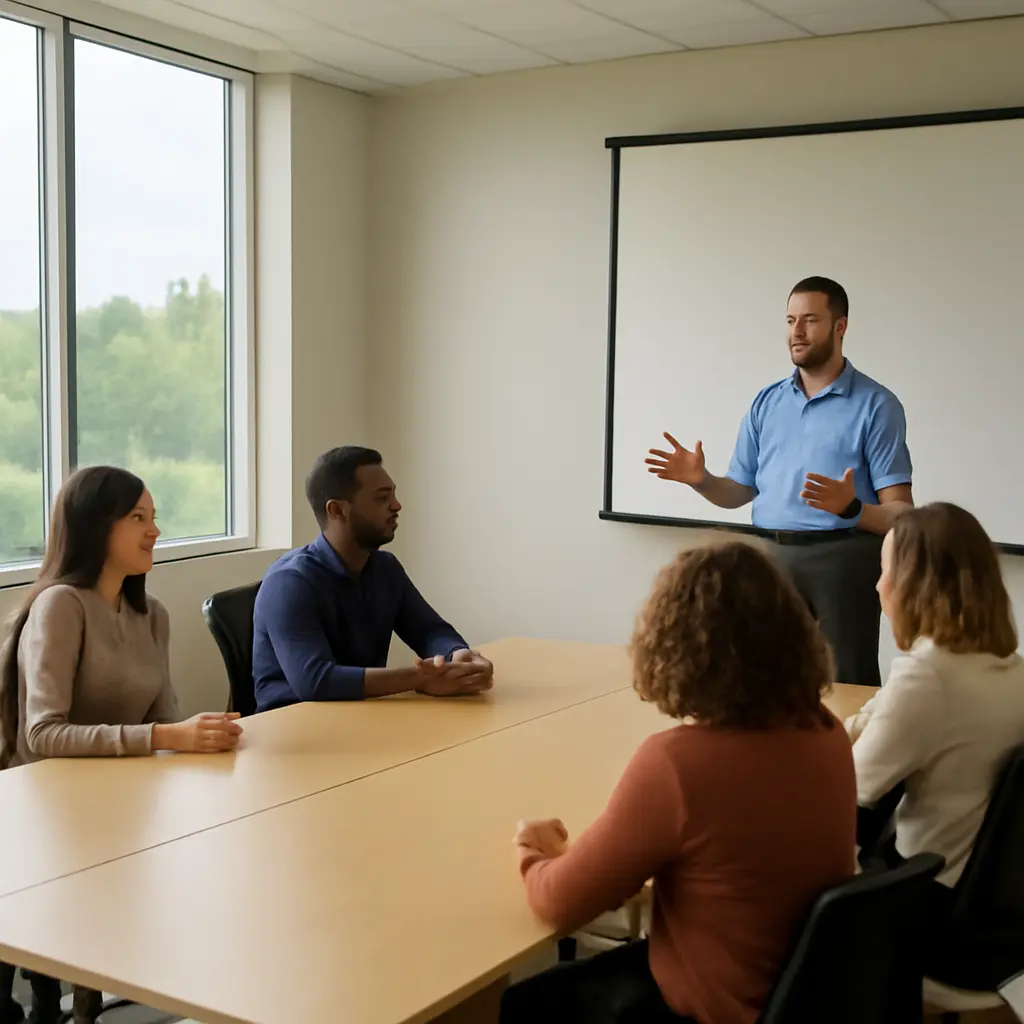
A workshop is a structured, hands-on learning session designed to help participants practice a skill; a seminar is typically a discussion- or presentation-based gathering organized around a subject and its people. That difference helps explain the provocative idea that “workshops teach you skills, but seminars teach you who matters”: workshops tend to make learning visible through practice, while seminars can make professional relationships, reputations, and institutional influence more visible. The distinction is not absolute, and networking outcomes depend on design, access, and follow-up. Still, evidence that professional connections can shape opportunity makes it useful to examine what each format teaches, how seminars reveal networks, and how to participate without mistaking visibility for expertise.
Workshops develop practical skills through active learning
A workshop is an instructional event in which participants work on a task, apply a method, or practice a capability, often with feedback from a facilitator. The Association for Talent Development describes workshops as learning experiences centered on participation and skill application. The defining feature is not simply a small room or short duration: it is the opportunity to do the work, receive guidance, and improve.
Workshops include several related formats: technical labs, writing clinics, design sprints, simulations, peer-learning sessions, and professional-development exercises. A coding lab may ask learners to debug a program; a facilitation workshop may have them run a meeting and reflect on it. In both cases, the intended result is observable practice rather than familiarity with a topic alone.
Practice, feedback, and transfer
Practice means attempting a task; feedback identifies what worked and what should change; transfer is the use of learning in a real setting after the session. These elements help distinguish a substantive workshop from a lecture labeled as one. The National Academies’ review of learning research emphasizes that effective learning builds on prior knowledge, active engagement, and opportunities to apply ideas. A workshop that includes a realistic exercise and specific feedback is therefore more likely to support usable competence than one that only presents information.
What workshop outcomes can—and cannot—show
A completed exercise, revised draft, or demonstrated technique can provide evidence of immediate learning. It does not, by itself, prove long-term mastery or workplace impact; those require follow-up measures and opportunities to use the skill. Workshop organizers can improve transfer by sharing job aids, setting practice goals, and arranging later coaching. This emphasis on measurable capability contrasts with a seminar’s often less formal lessons about fields, institutions, and people.
Seminars make professional networks and influence more visible
A seminar is a gathering for focused instruction, discussion, or the exchange of ideas, often involving a speaker, panel, or group of participants. Seminars can teach substantive knowledge, but they also create occasions to observe who convenes the conversation, whose questions receive attention, and which relationships connect people across organizations. In this sense, “who matters” refers not to an objective ranking of human worth, but to the people and institutions that currently hold visibility, expertise, resources, or decision-making influence in a particular field.
Seminar formats include research talks, policy roundtables, industry panels, academic colloquia, and invited-speaker events. Their networking value varies: a small discussion with time for introductions offers different access from a large auditorium presentation. The event’s guest list and conversation structure can make professional networks easier to see, but visibility should not be confused with competence or broad consensus.
Networks can shape access to opportunity
A professional network is the set of relationships through which people exchange information, advice, referrals, and collaboration. Research by sociologist Ronald Burt on “structural holes” describes how people who connect otherwise separate groups can gain access to novel information and brokerage opportunities. The concept helps explain why introductions and cross-group relationships can matter: they may expose participants to ideas or openings unavailable within a single circle. It does not mean that status alone guarantees good judgment or that every influential connection produces a fair outcome.
A large-scale LinkedIn research project published in Science examined how social connections affected job mobility for more than 20 million users. The researchers found that moderately weak ties—professional acquaintances rather than close friends—could increase job transmission, with the relationship varying by industry. This finding supports a careful version of the seminar claim: professional events can help people encounter useful connections, but outcomes depend on the quality and diversity of those ties, not simply on being near a famous speaker.
Status, expertise, and institutional influence are different
Status is social recognition; expertise is demonstrated knowledge or skill; institutional influence is the capacity to affect decisions through a role, organization, or control of resources. A seminar may reveal all three, but they are not interchangeable. A prominent keynote speaker may have substantial influence while a less visible researcher supplies the strongest evidence. Participants should evaluate claims by their methods, evidence, and relevance, rather than treating a speaker’s position or popularity as proof.
The National Academies’ work on scientific communication and consensus illustrates why this distinction matters: credible conclusions depend on evidence assessment and transparent reasoning, not merely on a person’s prominence. In practice, a seminar attendee can learn both the field’s formal ideas and its social map, while remaining alert to whose perspectives are absent from the room.
The workshop–seminar distinction is useful, but not absolute
The formats overlap. A workshop may include networking and influential mentors; a seminar may teach a demanding technical method. The more useful distinction is the event’s primary mechanism: workshops generally prioritize guided practice, while seminars generally prioritize shared discussion, presentation, and exchange. Many effective programs combine both, pairing expert talks with exercises and structured opportunities for participants to connect.
A practical example: a research conference
Consider a conference that offers a morning methods workshop and an afternoon seminar. In the workshop, attendees might learn a statistical technique by analyzing a sample dataset and receiving feedback. In the seminar, they might hear researchers debate the technique’s limits, discover which laboratories are developing it, and identify potential collaborators. The first session primarily builds capability; the second can reveal the field’s active questions and relationships. Attendees gain most when they use both forms of learning and assess each speaker’s claims critically.
Access and inclusion affect who becomes visible
Seminar networks are not automatically open or representative. Cost, location, caregiving responsibilities, disability access, invitation practices, and informal social norms can affect who attends and who gets heard. The National Center for Education Statistics and the U.S. Bureau of Labor Statistics document persistent differences in educational and occupational participation across demographic groups, while professional organizations have reported barriers to advancement in specific fields. These broader patterns caution against interpreting a room’s visible hierarchy as a complete picture of talent. Hybrid access, transparent speaker selection, accessible venues, and moderated question periods can widen participation.
How to learn from both formats
Participants can approach workshops and seminars with different goals. For a workshop, identify the skill to practice and ask for feedback that can be applied afterward. For a seminar, prepare a question, listen for evidence as well as institutional context, and seek conversations that extend beyond the most prominent attendees. After either event, follow up with a concise note, share a useful resource, or arrange a specific next step rather than relying on a single brief encounter.
- Before attending, check the agenda, facilitator or speakers, accessibility provisions, and intended learning outcomes.
- During a workshop, practice actively and record feedback; during a seminar, distinguish evidence, interpretation, and opinion.
- Build a broader network by speaking with peers and emerging contributors as well as senior figures.
- Afterward, apply one skill or idea and follow up on one meaningful connection.
Conclusion: skills and relationships are complementary forms of learning
Workshops are strongest when they develop practical capability through practice, feedback, and transfer. Seminars can provide subject knowledge while making professional networks, institutional influence, and field priorities more legible. Research on weak ties and professional networks supports the idea that relationships can affect access to information and opportunity, but status is not the same as expertise, and a seminar’s visible hierarchy is never the whole field.
Treat the phrase “workshops teach you skills, but seminars teach you who matters” as a useful prompt, not a universal rule. Choose events according to what you need to learn, pay attention to who is included, and turn both practical lessons and new connections into thoughtful action. For further reading, explore research on active learning, professional networks, and inclusive event design.
Sources: National Academies of Sciences, Engineering, and Medicine, How People Learn II: Learners, Contexts, and Cultures, 2018, https://nap.nationalacademies.org/catalog/24783/how-people-learn-ii-learners-contexts-and-cultures; Burt, Ronald S., Structural Holes: The Social Structure of Competition, Harvard University Press, 1992, https://www.hup.harvard.edu/books/9780674843714; Rajkumar, Karthik, et al., “A causal test of the strength of weak ties,” Science, 2022, https://www.science.org/doi/10.1126/science.abl4476; National Academies of Sciences, Engineering, and Medicine, Communicating Science Effectively: A Research Agenda, 2017, https://nap.nationalacademies.org/catalog/23674/communicating-science-effectively-a-research-agenda; Association for Talent Development, Training and Development Definitions and Resources, https://www.td.org/; National Center for Education Statistics, Digest of Education Statistics, https://nces.ed.gov/programs/digest/; U.S. Bureau of Labor Statistics, Labor Force Statistics from the Current Population Survey, https://www.bls.gov/cps/.